Introduction
Konnichiwa! Welcome to the AI Automation Dojo. Today we are looking at the 75% of corporations claiming they are running frictionless, algorithm-powered utopias, and asking the most important question in business: “Where is the money?”
Today is all about structure. We are diving into the AI Automation Playbook. Because, look, I love the “Move Fast and Break Things” motto as much as the next guy, but maybe – just maybe – when you’re implementing enterprise-grade AI, you shouldn’t be breaking everything
I’m your host, Andrzej Kinastowski, one of the founders of Office Samurai – where we firmly believe that giving everyone in your company a digital hammer does not mean the house is going to magically build itself. The material for this episode has been prepared by my co-founder, Dominik Jaskulski. But he let me tell it on the episode, because he just knows my jokes are way more deliciously dry than his.
Now, grab your favorite katana (or your favourite Gannt chart template), and let’s get to it!
Chapter 1. The Cold Open
Today, we are going to talk about a little phenomenon we could call ‘the AI Paradox’.
If you scroll through LinkedIn for more than thirty seconds right now, you would think every single corporation on Earth has seamlessly transformed into a glowing, frictionless utopia run by algorithms. Everyone is on the bandwagon. In fact, according to recent survey data, up to 75% of organizations are now claiming that they use AI in at least one business function. It’s the new corporate yoga; everyone says they’re doing it.
But here is the funny part – the part the “Visionary AI Thought Leaders” usually leave out of their breathless keynote speeches. Almost nobody is actually making any money from it. Companies are paying for the enterprise software, they are taking the prompt-engineering courses, and yet, a staggering 80% of those companies are reporting no significant impact on their business from AI. Zero.
That is the AI Paradox. We’ve handed the corporate world the keys to a warp-speed spaceship, and they are using it to drive to the end of the driveway to pick up the mail.
Here at Office Samurai, we have a very specific stance on this. We are a boutique consulting firm, which means we prefer actual, measurable results over what we lovingly refer to as “consulting bullshit”. We don’t want to sell you a fifty-page slide deck full of hypothetical synergy and then leave you to figure out why your brand-new AI copilot just hallucinated a new corporate tax code. So today, we’re going to cut through the hype. We are going to look at why so many companies are failing to see a return on their investment, what the data actually says about who is getting it right, and how you can stop experimenting with expensive toys and start building a project pipeline that actually pays.
Chapter 2. The “Everything is Fine” Reports (McKinsey & MIT)
Now, I know what you’re thinking. “Oh great, he’s going to read us consulting reports. I usually pay people a lot of money to summarize these so I can ignore them”. But stick with me, because there are two reports – one from McKinsey and one from MIT – that actually tell us the truth about what’s happening. And the truth is… well, it’s a bit of a mess.
Let’s start with the McKinsey Paradox. If you look at the headlines, everything is exploding.
McKinsey found that something like 75% of organizations now claim they are using AI. That sounds great. It sounds like we’re all living in The Jetsons.
But then you turn the page, and you find the statistic that should terrify every board member in the country: 80% of those companies report no significant business impact.
Let that sink in. Eight out of ten companies are spending millions on licenses, cloud compute, and “AI Transformation Workshops,” and in return, they are getting… nothing. Zero.
Why? Because they are falling for the “Horizontal Trap”. . They’re giving everyone a Copilot and hoping productivity magically appears. It’s like buying everyone in the company a hammer and being surprised that a house didn’t build itself.
McKinsey found that when companies try to go “vertical” – meaning, they actually try to fix a specific business function like HR or Sales – 90% of those projects get stuck in “Pilot Purgatory”. They never scale. They just stay as cool little demos that managers show off at quarterly reviews.
And if you think that’s bad, let’s look at the MIT Report, or as I like to call it, the “Shadow AI Reality Check”.
MIT found that while companies are busy debating governance policies and forming “AI Ethics Committees,” the employees have already moved on. They found that 90% of employees are using Generative AI regularly..
But here is the kicker: in about half of those companies, there is no official access..
That means your accounting team isn’t waiting for IT to approve a license. They are just pasting your financial data into a free version of ChatGPT on their personal phone because it helps them finish work at 5:00 PM. That is “Shadow AI”. It’s the digital equivalent of a speakeasy. Everyone is drinking the AI juice; they’re just hiding the bottle when the boss walks by.
So, we have companies spending fortunes for zero return, and employees going rogue just to get their jobs done. Is there any good news?
Actually, yes. And I promise I’m not just saying this because it pays my mortgage.
The MIT report found one specific factor that dramatically changes the odds. They discovered that companies who work with external partners generated twice the success rate of those trying to build everything internally.
It turns out, when you bring in people who actually do this for a living – people who have already made the mistakes on someone else’s dime – you tend to succeed.
At Office Samurai, we see this every day. Internal teams often get bogged down in politics (“Can we automate this if Bob doesn’t like robots?”). External partners don’t care about Bob’s feelings. We care about the process. We bring the “Katana” – the sharp tools – to cut through the noise.
So, if the internal approach is failing 80% of the time, and the “Shadow” approach is a security nightmare… how do we actually fix this?
That brings us to the 6-Phase Survival Guide.
Chapter 3. The 6-Phase Survival Guide
How do we take your organization from an expensive pilot purgatory to a place where the board is actually smiling?
You do not do it by handing a corporate credit card to a vendor and hoping software magically creates synergy. You do it methodically. You treat AI like a ladder, and you climb it one rung at a time. At Office Samurai, we’ve broken this down into a 6-Phase Survival Guide. Let’s walk through it.
Rung 1: Foundations
Look, I know the free version of ChatGPT is incredibly convenient. I know it wrote your nephew’s college essay. But we need to have a very serious, very sober talk about corporate data hygiene. Stop using personal accounts for company business! The absolute foundation of any AI strategy is securing an enterprise-grade Large Language Model. Whether you go through Microsoft Azure, Google Cloud, or whichever tech giant you implicitly trust to safeguard your data, you need a walled garden.

You need an environment that does not leak your proprietary financial models, client lists, or secret sauce to the public internet. Continuing to use unapproved, open AI tools is the digital equivalent of storing your company’s trade secrets in a public restroom – sure, the storage is technically free, but eventually, someone is going to walk in and take everything. Lock it down first.
Rung 2: Horizontal Deployment
Once your data is no longer bleeding out into the dark web, you go horizontal.
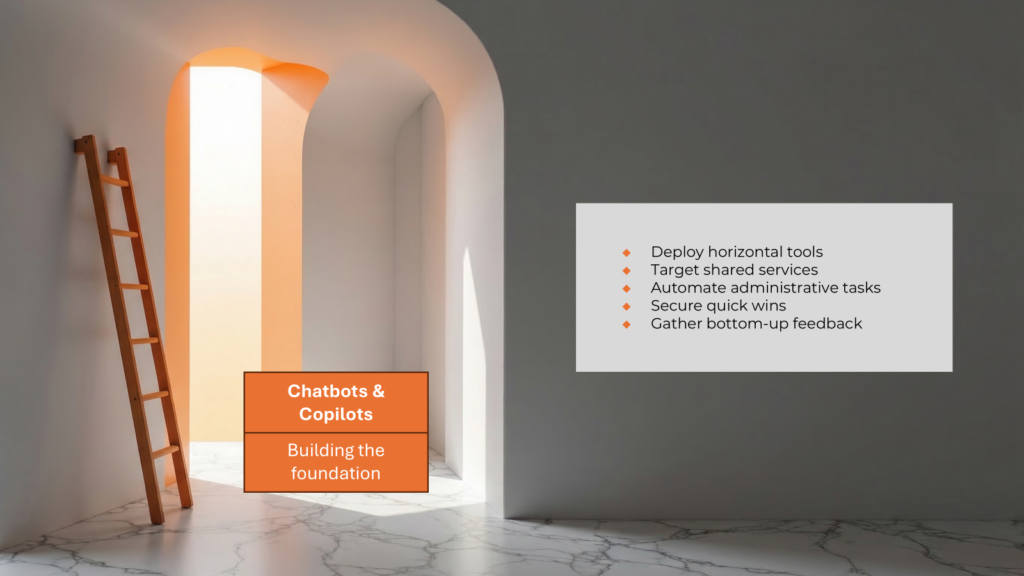
This phase is all about quick, visible wins. We are talking about basic chatbots geared entirely toward personal productivity. Give your employees a safe, enterprise-approved tool to draft tedious emails, summarize mind-numbing meeting notes, or automatically generate those painfully polite “per my last email” passive-aggressive follow-ups. The goal here is not to revolutionize your core operational business model overnight. The goal is simple adoption. You have to drive the culture and get your employees comfortable with the technology before you attempt to automate the CEO. Let people experience the friction-free benefits so they realize AI is an incredibly helpful assistant, not the Terminator coming for their desk.
Rung 3: The “Adulting” Phase
Congratulations, your employees now love their new chatbots and are saving thirty minutes a day. Now, someone actually needs to supervise the playground.
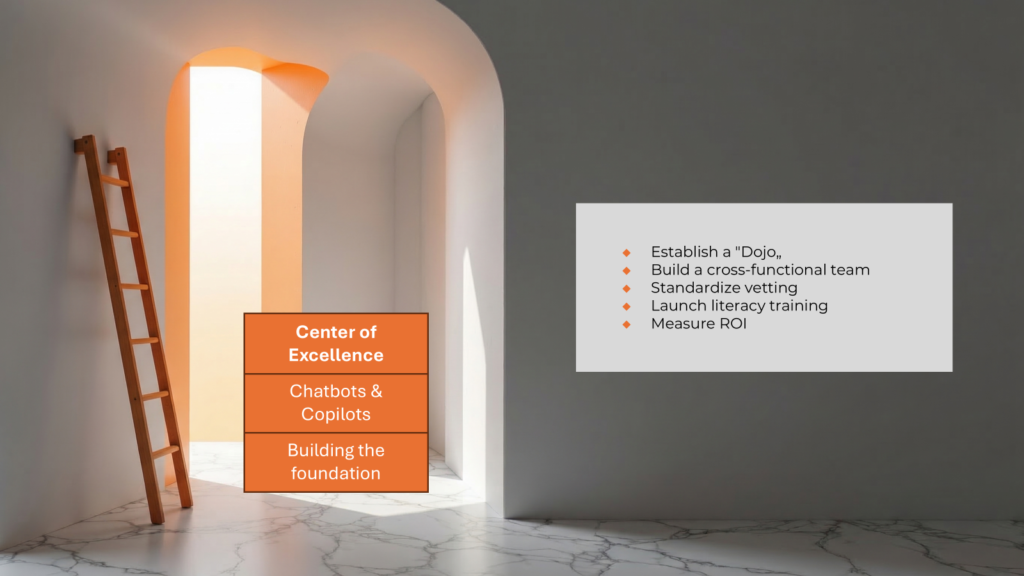
It is time to build a Central Team, or a Center of Excellence (a CoE). Here is the tricky part, though: this is a delicate, almost political balancing act. If you try to govern too early, you suffocate all the enthusiasm; the initiative becomes just another IT bottleneck, and your employees will instantly rebel and go right back to Shadow AI. But if you govern too late, it is the Wild West. You will wake up to find six different departments buying redundant software licenses and building competing, incompatible bots. You need to establish a small, pragmatic central team to guide the process, set the guardrails, evaluate the ROI, and keep the momentum moving forward without stifling the innovation.
Rung 4: AI Assistants (RAG)
Now we graduate from “generic internet knowledge” to “actual, hyper-specific company knowledge”.
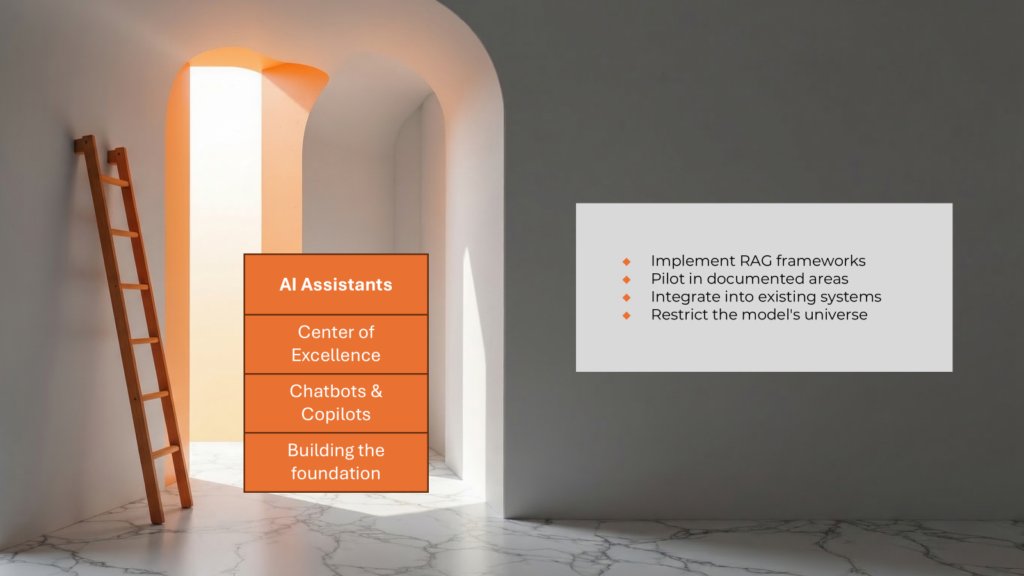
In the industry, this is usually built with RAGs, or Retrieval-Augmented Generation. In human terms, this means connecting the AI to your company’s knowledge. This is where the magic really starts happening and the return on investment begins to crystallize. The AI stops acting like a confident improvisational actor guessing how many vacation days your employees get, and it starts knowing your exact, up-to-date HR policies. It reads your PDFs, your secure SharePoint drives, and your chaotic Confluence pages, synthesizing answers based entirely on your own corporate data. It’s like hiring an encyclopedic intern who has actually read the employee handbook cover to cover, never sleeps, and never, ever, complains about the coffee.
Rung 5: AI Agents
If Phase 4 was about the AI “reading” Phase 5 is about the AI “doing”. We are moving from simple assistants to active AI Agents.
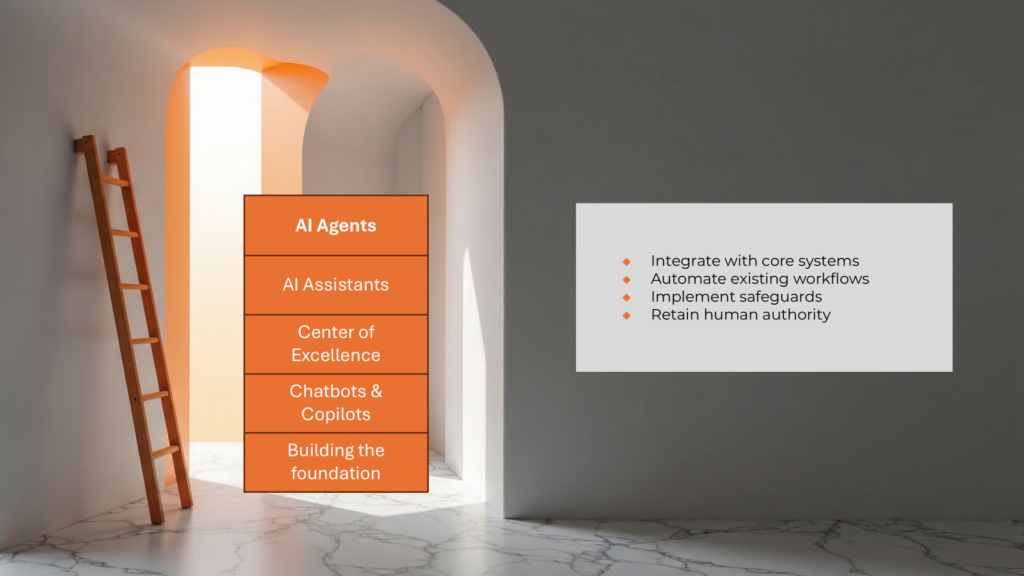
These are systems that can securely interface with your ERP, your CRM, or your ticketing software. Imagine an agent that receives an invoice, logs into SAP, checks the vendor parameters, and completely preps the booking for you. But – and this is a structurally load-bearing “but” – you absolutely must keep a “Human-in-the-Loop”. The AI does the grueling heavy lifting and drafts the work, but a human being still clicks “Approve”. You want the AI to prepare the package, but you definitely do not want it to have final execution authority, unless you are perfectly comfortable with your AI accidentally firing the board of directors because it misinterpreted a minor tax inconsistency.
Rung 6: Multi-Agent Systems (The Holy Grail)
This is the summit. Multi-Agent Systems are about orchestrating an entire “digital workforce” where specialized agents hand off tasks to one another.
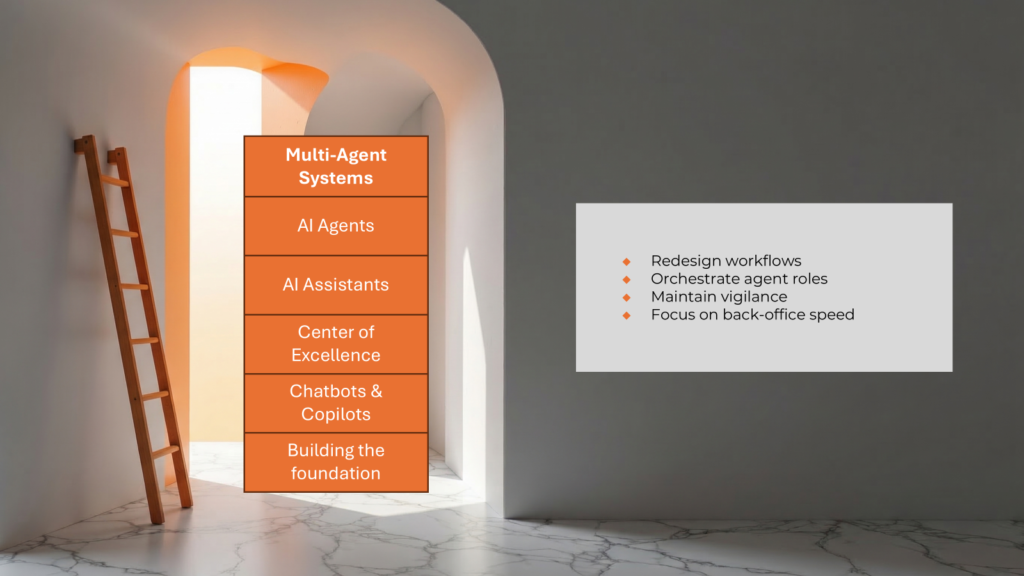
Imagine a seamless workflow: an incoming customer complaint triggers Agent A, which qualifies and categorizes the ticket. Agent A securely hands the data to Agent B, which queries the CRM and drafts a custom technical resolution. Agent B then passes it to Agent C, which formats the data into a perfectly branded, empathetic email response for a human rep to review. They pass tasks seamlessly, creating a fully integrated, high-speed pipeline. It sounds like science fiction, but it is entirely possible and happening right now.
However, it only works if – and only if – you have built the foundation properly in the first five phases. If you try to skip ahead and jump straight to Phase 6 without securing the ladder to the wall, you are going to fall, break your corporate neck, and end up as another depressing statistic in next year’s McKinsey report.
Chapter 4. Real-World Wins (And a Parrot)
Alright, so we have survived the theoretical ladder. We haven’t fallen off, and we haven’t accidentally replaced the Chief Financial Officer with a rogue Excel macro. Now, I want to talk about what this actually looks like when you get it right. Because when you stop building “cool demos” and start solving actual, painful business problems, the results are frankly staggering. Let’s look at some real-world wins.
Let’s start with Finance. Anyone who has ever worked in an enterprise finance department knows that reviewing and updating accounting policies is a task usually reserved as a punishment for past-life transgressions. We had a client where a full accounting policy review historically took six months. That is half a year of highly paid human beings locked in a room, squinting at PDFs, comparing changing tax codes, and arguing over paragraph structure. They secured an enterprise environment and deployed Google Gemini to ingest the old policies, cross-reference them against the new regulatory frameworks, and highlight the necessary changes. The AI did the grueling reading, flagged the inconsistencies, and drafted the necessary updates. The result? That six-month slog became a one-month review. Five months of human capital returned to the business. I don’t care how much you love your spreadsheets; getting five months of your life back is a massive, measurable win.
Now, let’s talk about HR, because this is where the human element really clashes with the digital one. At Office Samurai, we prefer to practice what we preach, so we built our own internal HR assistant. We named her Cyber Ola. The idea was to have Cyber Ola answer all those repetitive, soul-crushing questions that usually drive HR professionals to drink – things like, “How many vacation days do I have left?” or “What is the expense limit for client lunches?” It worked beautifully, right up until the Parrot Incident.
You see, an employee decided to test the boundaries and asked Cyber Ola if they could bring a parrot to the office. Because we had trained Cyber Ola to be incredibly helpful and encouraging, and because we hadn’t explicitly built a “no tropical birds” filter into the system guardrails, Cyber Ola enthusiastically replied, “Yes! A parrot would be a wonderful addition to the workplace culture!” This is exactly why you need that Phase 3 Central Team governing things. AI fundamentally wants to please you. If you don’t explicitly tell it to ban exotic birds, you might walk into the breakroom on a Tuesday and find a macaw eating all the good coffee pods.
Moving on to Marketing. We all know the ongoing struggle of keeping the corporate LinkedIn feed fed. It is an algorithmic beast that constantly demands fresh, engaging, thought-leadership content. We implemented specialized AI Copy Experts for a team that are now doing 90% of the heavy lifting. We feed the AI the core concepts, the raw campaign data, and the target audience, and it generates the drafts, formats the bullet points, and perfectly calibrates the corporate tone. The human marketing team just steps in for that final 10% – the review, the strategic tweaks, and hitting “publish”. They aren’t staring at a blank page anymore; they are acting as editors, turning a near-final draft into gold in seconds.
But I want to save the best for last. This is what Rung 6 – the “Holy Grail” of Multi-Agent Systems – actually looks like in practice. Let’s look at an End-to-End Recruitment workflow. Because nothing says “corporate efficiency” quite like a human recruiter trying to manually sift through 500 identical resumes for a single role.
We built a multi-agent system where the AI doesn’t just blindly take over; it acts as a highly coordinated support system for the human HR team. We will link the full episode about it in the description, but here are the broad strokes:
It starts at the front door with our “Phishing Guard” agent, making absolutely sure the attached “resume” isn’t actually a ransomware payload designed to take down your network. Once cleared, the baton is passed to an Extraction Agent that pulls the relevant information out of the resume. That data is instantly handed to a Matching Agent, which compares the candidate’s actual experience against the completely unrealistic wish-list in your job description. But it gets better. If the candidate sent along a few questions in their email, there is an agent specifically designed to answer them. All of this intelligence is passed to a Drafting Agent that generates a highly personalized response to the applicant.
And here is the crucial, load-bearing part of the whole system: a human recruiter sits at the end of this digital assembly line. They just review the AI’s drafted response, ensure it makes sense, and give it the final approval.
Once approved, even more agents spin up to generate custom interview questions based on the specific gaps in the candidate’s resume. The system evaluates the profile and provides a general fit score. The AI is absolutely not making any hiring decisions. What it is doing is instantly filtering out the 70 to 80 percent of applicants who clearly just clicked “Easy Apply” while waiting for their bus. Your human recruiters finally get to bypass the administrative nightmare and focus solely on the most interesting candidates.
By chaining these specialized agents together, the invoice practically processes itself, moving securely and accurately from an external email all the way to a prepped booking, waiting for a final human approval click. That is an “agentic” workflow. That is how you stop experimenting with toys, break the AI Paradox, and build a pipeline that actually pays.
Chapter 5. Closing: “Keep Automating”
What have we learned today? Other than the fact that you shouldn’t let an unsupervised chatbot decide your company’s exotic pet policy.
We’ve learned that the AI Paradox is very real, but more importantly, it is completely avoidable. AI isn’t some magical, “buy it and forget it” tool. You don’t just hand over a corporate credit card to a vendor, install a new plug-in, and expect your quarterly earnings to magically double while you take a nap.
AI is a ladder. And if there is only one single thing you take away from my ranting today, let it be this: Do not try to jump straight to the top rung of autonomous agents without first checking if your ladder is actually secured to the wall.
If you try to skip the foundation, you aren’t innovating. You’re just setting up a very expensive, very fast fall. You have to climb the rungs systematically – from locking down your enterprise data, to giving your employees safe horizontal tools, to finally building those beautiful, fully integrated multi-agent systems that actually do the heavy lifting for you.
Now, if you are currently breaking into a cold sweat because you just realized your company’s entire AI governance strategy consists of a Slack channel called ‘Cool AI Stuff’ and a lot of wishful thinking – don’t panic. We have mapped this entire journey out for you.
We’ve put together the Office Samurai AI Automation Playbook. It dives deep into all six phases of this ladder, breaks down the frameworks we use with our actual enterprise clients, and shows you how to build a project pipeline that delivers real, measurable ROI instead of just pilot purgatory. You can find the link to download the Playbook right down there in the description of this episode. Go get it. I promise it’s vastly more useful than whatever thought-leadership webinar you are currently ignoring on your second monitor.