
Measure, analyze and automate business processes using AI.
At Office Samurai, we help enterprise organisations reduce operational costs by up to 25% and increase productivity by more than 50% by combining Process Intelligence with AI-driven automation.

More than 80 enterprise organisations across EMEA and North America have shifted from “guessing” to “knowing”. One-off projects are not the point. We build long-term partnerships with customers who treat automation and operational excellence as a strategic priority, not a side initiative.


In Office Samurai we choose the right tools to solve different challenges. Our “understand first” approach means we will first help you analyze and understand the problem – using either classical process analysis or modern Process Intelligence tools. Then our experts will help you find and implement a proper solution.
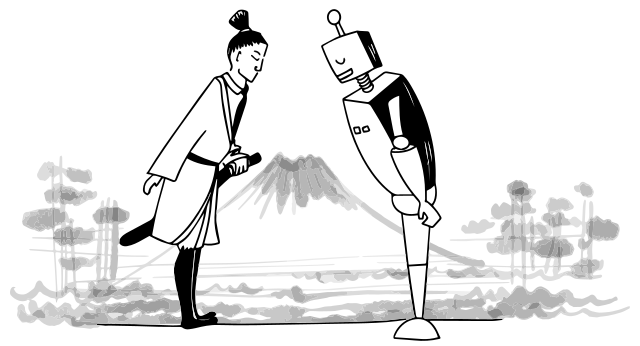

During the AI gold rush, it is easy to overreact or go in the wrong direction. Using Process Intelligence or our Process Discovery methodology, we can quickly analyze your entire organization and point areas where AI can deliver real ROI.
Help! I’m under pressure to implement AI!
During the AI gold rush, it is easy to overreact or go in the wrong direction. Using Process Intelligence or our Process Discovery methodology, we can quickly analyze your entire organization and point areas where AI can deliver real ROI.

Driving a 10% or 15% operational efficiency requires more than just a goal. It has to expose “hidden capacity”. We identify where your team is “stuck” in non-value-added work. Thanks to our analysis you will understand how big is your productivity gap and where are the opportunities for improvement or AI automation (and what ROI they will bring).
We can’t increase efficiency any further
Driving a 10% or 15% operational efficiency requires more than just a goal. It has to expose “hidden capacity”. We identify where your team is “stuck” in non-value-added work. Thanks to our analysis you will understand how big is your productivity gap and where are the opportunities for improvement or AI automation (and what ROI they will bring).

The first steps are the most expensive ones. Without facts, AI automation quickly hits a dead end. We provide a data-driven roadmap based on how work actually runs, identifying high-value AI automation use cases and calculating the business case before we help you build the AI solution or implement automation workflow.
I don't know where to start with AI
The first steps are the most expensive ones. Without facts, AI automation quickly hits a dead end. We provide a data-driven roadmap based on how work actually runs, identifying high-value AI automation use cases and calculating the business case before we help you build the AI solution or implement automation workflow.

There can be many reasons for that: expensive software or tokens, wrong AI implementation, high maintenance costs, lack of automation strategy. We can help you find balance and then select optimal AI solutions to solve different problems in your organisation.
Our AI and automation projects don’t generate ROI
There can be many reasons for that: expensive software or tokens, wrong AI implementation, high maintenance costs, lack of automation strategy. We can help you find balance and then select optimal AI solutions to solve different problems in your organisation.

You are lucky – we are full of them! By analyzing in real time how work actually gets done, we uncover improvement potential that never appears in process maps. This is where the next 10% to 20% of efficiency hides.
I’m running out of ideas for improvement
You are lucky – we are full of them! By analyzing in real time how work actually gets done, we uncover improvement potential that never appears in process maps. This is where the next 10% to 20% of efficiency hides.

Our approach respects enterprise security requirements by design. Data access, governance, and compliance remain under your control, with full transparency into what is captured, processed, and automated. Our solutions use H-I-T-L (Human-In-The-Loop) to properly control and uptrain AI models.
Is it safe for my company to implement AI?
Our approach respects enterprise security requirements by design. Data access, governance, and compliance remain under your control, with full transparency into what is captured, processed, and automated. Our solutions use H-I-T-L (Human-In-The-Loop) to properly control and uptrain AI models.

Office Samurai helps organisations first analyze, then understand, and finally change their business processes – in that exact order. Our #NoBullshit policy is a core value: we refuse to automate a broken process and always recommend the best solution, if it means going separate ways with customer. We educate and guide to the best of our knowledge.
Office Samurai works closely with selected Process Intelligence and AI technology providers. We choose tools and methods based on the problem at hand, not vendor preference.
Our role goes beyond delivery. We act as a strategic partner focused on building lasting capabilities on the client side, regardless of their starting point or level of maturity.
Others are happy to deploy bots and agents on broken processes – more build time means more billing. But we operate by a different code. Process Intelligence acts like an MRI for your operations, showing exactly where AI automation will generate ROI and where it will burn budget. We are small enough to care about your EBITDA but experienced enough to handle enterprise scale.
01.
One partner delivering the full service
We cover everything you need to run a successful AI automation or process improvement program. You work with one accountable team instead of juggling multiple vendors. That means fewer handovers, fewer misunderstandings, and faster execution. Our engagement model is flexible, so we can onboard quickly and adjust to your internal setup without slowing you down.
02.
Extend your horizons with AI automation + Process Intelligence
Automation alone just makes a bad process run faster. We use Process Intelligence to provide a data-driven scan of your business before writing a single line of code. By visualizing hidden inefficiencies and quantifying productivity gaps, we ensure you only automate what is actually worth automating.
03.
Team up with industry leaders
Unlike the Big 4, we don’t send juniors to learn on your projects. You get access to seasoned “Samurais” – certified experts and UiPath Diamond Partners who have delivered over 500 of successful implementations.We also partner with leaders like KYP.ai and Soroco to bring advanced productivity into your transformation program.
04.
Experience radical transparency
We mean it. Our #NoBullshit policy is a core company value supported by all our employees. We don’t deceive clients – instead, we always openly recommend the best solutions to solve the problem, even if it means advising against working with us.
05.
Benefit from Lean-driven AI Automation
Automation alone does not fix a broken process. If you automate waste, you just scale it. Process Intelligence gives objective data on how work runs, where value is created, and where time is lost. This is how you know AI will generate real return and where it is simply not worth the investment.
06.
Gain skills and independence
We don’t believe in “vendor lock-in”. Through hands-on collaboration, training sessions, and practical knowledge sharing, your team will learn how to manage and scale AI automation on its own.
We deliver an end-to-end ecosystem for business transformation and AI automation. While our services can be targeted to specific needs, they are most effective as a complete, integrated program that eliminates ‘digital waste’ and builds lasting internal capability. One team, one contract, and total accountability for your digital transformation
AI Solutions
From discovery to intelligent solutions.
We cover the full AI journey: from data-driven AI Discovery and Process Intelligence, to the orchestration of AI Agents and specialized solutions for document and communication handling.
Our team designs AI systems securely, ensuring they operate reliably within your enterprise.
Read more

Automation (RPA)
Scalable execution across your systems.
We design and manage automation environments, from CoE setup and managed services to platform support and migrations.
Whether it’s SAP automation, license optimization, or stabilizing existing automation landscapes, we ensure your automation runs reliably and delivers measurable results.
Read more

Process Excellence
See the operational truth.
Improvement starts with understanding how work actually runs. Through Process Intelligence, Process Discovery, and lean management, we expose delays, rework, and inefficiencies hidden in daily operations.
This creates a fact-based roadmap for deciding what to fix, what to automate, and what to stop.
Read more

Training
The strength comes from the inside.
We equip your teams with practical skills in AI, Automation, and Process Improvement. Analysts, managers, and technical teams learn how to govern, scale, and improve solutions independently.
The goal is clear: capability inside your organisation, not dependency on vendors.
Read more
Make the first step towards improving your business processes. Type in your email – we will contact you in 1 business day.

Read about cases that make automation practical, not theoretical. Or just enjoy your morning coffee.
AI Automation Dojo by Office Samurai
Tired of processes so old they remember when “the cloud” was just a weather phenomenon? The Office Samurai Podcast gets to the heart of modern business, showing that AI and automation are more than just buzzwords your boss likes to throw around. We explore practical ways GenAI, RPA, and intelligent automation can truly transform business processes.
Tired of processes so old they remember when “the cloud” was just a weather phenomenon? The Office Samurai Podcast gets to the heart of modern business, showing that AI and automation are more than just buzzwords your boss likes to throw around. We explore practical ways GenAI, RPA, and intelligent automation can truly transform business processes.
35,000 vs 17,000 actions a day: the top performers your reports don’t see
In transactional operations, a low performer completes up to 17,000 actions a day. A top performer completes 35,000. Standard reports don’t show that gap, and they don’t show who carries the load. Adam Bujak, CEO of KYP.ai, has a name for many of them: an “army of high-performing introverts” who support several teams, never talk up what they contribute, and end up working after midnight until they burn out.
The same blind spot drives bad automation decisions. In his Capgemini days, Bujak watched finance teams put “a few millions” into RPA and get back about 80k in savings, even with 280 business analysts hunting for use cases. When a process runs in countless variants and the licence costs too much, a bot only automates the chaos.
KYP.ai was built to close that gap: see what’s happening, understand the details, then change things to get the outcome. Continuous task mining instead of one-off workshops, and privacy-first data capture that collects only what the goal needs. The result is evidence about people, processes and automation that stands up in front of a CFO. One KYP.ai customer recently reached an ROI of 4,000%.
35,000 vs 17,000 daily actions ◆ “A few millions” in RPA, ~80k saved ◆ 4,000% ROI at one KYP.ai customer ◆
In transactional operations, a low performer completes up to 17,000 actions a day. A top performer completes 35,000. Standard reports don’t show that gap, and they don’t show who carries the load. Adam Bujak, CEO of KYP.ai, has a name for many of them: an “army of high-performing introverts” who support several teams, never talk up what they contribute, and end up working after midnight until they burn out.
The same blind spot drives bad automation decisions. In his Capgemini days, Bujak watched finance teams put “a few millions” into RPA and get back about 80k in savings, even with 280 business analysts hunting for use cases. When a process runs in countless variants and the licence costs too much, a bot only automates the chaos.
KYP.ai was built to close that gap: see what’s happening, understand the details, then change things to get the outcome. Continuous task mining instead of one-off workshops, and privacy-first data capture that collects only what the goal needs. The result is evidence about people, processes and automation that stands up in front of a CFO. One KYP.ai customer recently reached an ROI of 4,000%.
35,000 vs 17,000 daily actions ◆ “A few millions” in RPA, ~80k saved ◆ 4,000% ROI at one KYP.ai customer ◆
SPS: 50% less admin work, 25% more productive capacity – across 20+ countries
SPS runs multi-client BPO operations for banking, insurance and health from Zurich, with over 8,500 employees across more than 20 countries. Nothing was broken – governance and delivery were already mature. What was missing was real-time visibility into how work actually ran across regions, and a clean path from that data into billing.
KYP.ai supplied the intelligence layer: process signals captured from existing workflows, an Integration Database consolidating data from multiple systems, and validated data flowing straight into SAP via IDoc. Administrative alignment work dropped by more than half, productive capacity rose 25%, and two separate systems collapsed into one.
As implementation partner we ran the user needs analysis and process mapping, configured KYP.ai against how SPS actually works, and onboarded the teams as certified KYP.ai Platform Evangelists.
50%+ less admin work ⬥ 25% more productive capacity ⬥ 13 pp more time on client work ⬥ 2 systems → 1
SPS runs multi-client BPO operations for banking, insurance and health from Zurich, with over 8,500 employees across more than 20 countries. Nothing was broken – governance and delivery were already mature. What was missing was real-time visibility into how work actually ran across regions, and a clean path from that data into billing.
KYP.ai supplied the intelligence layer: process signals captured from existing workflows, an Integration Database consolidating data from multiple systems, and validated data flowing straight into SAP via IDoc. Administrative alignment work dropped by more than half, productive capacity rose 25%, and two separate systems collapsed into one.
As implementation partner we ran the user needs analysis and process mapping, configured KYP.ai against how SPS actually works, and onboarded the teams as certified KYP.ai Platform Evangelists.
50%+ less admin work ⬥ 25% more productive capacity ⬥ 13 pp more time on client work ⬥ 2 systems → 1
The Visio map vs. a busy Tuesday afternoon: what your reports don’t show
Corporate reports show results, the “what”, but not how the work actually gets done. That leaves a Visibility Gap between the clean process map drawn in Visio and the messy reality of a busy Tuesday afternoon. Most organisations fill that gap with assumptions, which the article calls “Corporate Fiction”, and end up making operational decisions on intuition rather than evidence.
KYP.ai closes the gap with task mining. Process mining reads structured logs from ERP and CRM systems. Task mining is “the camera inside the delivery truck”: it captures the work done on the desktop, in Excel, email and legacy apps. That’s where the differences show up. In a transactional setting, someone on the lower end hits around 17,000 actions a day, while a top performer reaches about 35,000.
The platform works in three steps: see, understand, change. It’s automation-agnostic, so it diagnoses the problem before recommending a fix. The fix might be RPA, a training programme, a change to the process, or simply better software. Privacy controls like app whitelisting and PII masking on the desktop are built in. Allied Global saw a 25% increase in active productive FTE. Hollard Insurance got a 20% productivity leap and saved 307 hours of manual work a month.
35,000 vs 17,000 daily actions ◆ +25% active productive FTE at Allied Global ◆ 307 hours saved a month at Hollard ◆
Corporate reports show results, the “what”, but not how the work actually gets done. That leaves a Visibility Gap between the clean process map drawn in Visio and the messy reality of a busy Tuesday afternoon. Most organisations fill that gap with assumptions, which the article calls “Corporate Fiction”, and end up making operational decisions on intuition rather than evidence.
KYP.ai closes the gap with task mining. Process mining reads structured logs from ERP and CRM systems. Task mining is “the camera inside the delivery truck”: it captures the work done on the desktop, in Excel, email and legacy apps. That’s where the differences show up. In a transactional setting, someone on the lower end hits around 17,000 actions a day, while a top performer reaches about 35,000.
The platform works in three steps: see, understand, change. It’s automation-agnostic, so it diagnoses the problem before recommending a fix. The fix might be RPA, a training programme, a change to the process, or simply better software. Privacy controls like app whitelisting and PII masking on the desktop are built in. Allied Global saw a 25% increase in active productive FTE. Hollard Insurance got a 20% productivity leap and saved 307 hours of manual work a month.
35,000 vs 17,000 daily actions ◆ +25% active productive FTE at Allied Global ◆ 307 hours saved a month at Hollard ◆
12 ERP systems, one employee: what task mining uncovered at Vesuvius
At Vesuvius, a global leader in molten steel products, one employee worked in 11 to 12 ERP instances every day. They all had the same names but different configurations, versions and layouts, and each one needed its own password. That’s what happens in a company that keeps buying businesses around the world, each with its own ERP. Elena Olichowska-Szydłowska, Automation Excellence Manager at Vesuvius, found this after she brought in task mining with KYP.ai instead of running Lean workshops with sticky notes.
It wasn’t the only thing the data showed. Record-to-Report teams were heading for burnout around month-end and year-end closes. In the same team, some people worked overtime while others had spare capacity, and monthly averages hid the difference. The data also showed that work could be shared out by how complex tasks really are, not just by how many there are.
To get there, Elena had to earn people’s trust first. Employees were afraid of being watched. So she started with a 13-person pilot, met each person one-on-one to explain what data was collected and who could see it, and presented the tool as a way to spot where people need support. Her one regret is not giving employees personal dashboards from day one. The investment paid for itself in 6 months. Vesuvius also cut its workforce by 8% without layoffs, by not replacing people who left.
11–12 ERP instances for one employee ◆ 13-person pilot ◆ Paid back in 6 months ◆ 8% smaller team, no layoffs ◆
At Vesuvius, a global leader in molten steel products, one employee worked in 11 to 12 ERP instances every day. They all had the same names but different configurations, versions and layouts, and each one needed its own password. That’s what happens in a company that keeps buying businesses around the world, each with its own ERP. Elena Olichowska-Szydłowska, Automation Excellence Manager at Vesuvius, found this after she brought in task mining with KYP.ai instead of running Lean workshops with sticky notes.
It wasn’t the only thing the data showed. Record-to-Report teams were heading for burnout around month-end and year-end closes. In the same team, some people worked overtime while others had spare capacity, and monthly averages hid the difference. The data also showed that work could be shared out by how complex tasks really are, not just by how many there are.
To get there, Elena had to earn people’s trust first. Employees were afraid of being watched. So she started with a 13-person pilot, met each person one-on-one to explain what data was collected and who could see it, and presented the tool as a way to spot where people need support. Her one regret is not giving employees personal dashboards from day one. The investment paid for itself in 6 months. Vesuvius also cut its workforce by 8% without layoffs, by not replacing people who left.
11–12 ERP instances for one employee ◆ 13-person pilot ◆ Paid back in 6 months ◆ 8% smaller team, no layoffs ◆