
Introduction
Konichiwa! Welcome to the AI Automation Dojo. Today, we are taking a sledgehammer to the most dangerous lie in modern management: “the monthly average”.
I’m your host, Andrzej Kinastowski, one of the founders of Office Samurai – where we prefer the harsh, quantifiable truth over a beautifully illustrated corporate mythology.
So, whether you are an operations manager trying to figure out why a five-minute task takes fifteen, or a frontline worker silently doing your laundry during a ten-person status update, you are in the right place.
Now grab your favorite katana – or that process mining dashboard you’ve been actively avoiding – and let’s get to it!
The corporate fairytale vs. raw operational data
Today, we are diving deep into a topic that keeps executives up at night, but is usually handled completely wrong: workforce productivity. We aren’t here to talk about squeezing more hours out of an already exhausted team or writing up another theoretical policy. Instead, we’re going to look at how big organizations can use Process Intelligence (which you might also hear referred to as task mining or productivity mining) to finally understand the reality of their operations. We are going to explore how looking at the raw data can eliminate the digital friction that is driving employees crazy, and unlock massive gains in efficiency without burning people out.
To understand why this is so critical, let’s start with a universal truth about the corporate world: every big organization has a story it absolutely loves to tell itself. If you walk into the headquarters and ask leadership how a process runs, they will happily hand you a perfectly sanitized, color-coded PowerPoint. You’ll see beautiful, official flowcharts, meticulously crafted training manuals, and perfectly balanced diagrams showing how evenly the workload is distributed across their highly efficient teams.
It is a fairytale. A beautiful one, but still a fairytale, of how work should happen. A story of dedicated employees and seamless execution. But if you zoom in and look at what’s actually happening on the ground? The messy truth is something else entirely.

In reality, day-to-day work is a chaotic cocktail of frantic workarounds, undocumented “Shadow AI” tools that people secretly use just to survive their overflowing inboxes, and massive productivity bottlenecks. The reality is that your employees are often doing their absolute best, but they are constantly fighting against the very systems and processes that are supposed to support them.
This is where Process Intelligence steps onto the stage. At Office Samurai we vastly prefer measurable reality over corporate mythology. Process Intelligence acts as the ultimate bullshit detector for your operations. It completely replaces the official corporate fiction with raw, unfiltered data showing exactly how work actually gets done on a random Tuesday afternoon.
You can think of this technology as an enterprise X-ray. Rather than relying on a manager’s “gut feeling” about who is busy and who has extra capacity, this X-ray illuminates everything. It captures the reality of every single click, every frantic task switch, and every clunky system interaction. Suddenly, you aren’t guessing where your bottlenecks are; you’re looking right at them. It cuts through the noise to reveal hidden capacity and the true digital friction that those perfect flowcharts conveniently left out.
Pillar 1: Smart workload balancing and operations steering
Now, let’s talk about the first major area where Process Intelligence completely changes the game: Smart Workload Balancing and Operations Steering.
If you manage a large operations team, there is a very good chance you manage by averages. You know the drill: “We process 10,000 invoices a month, we have 10 people on the team, so that’s a clean 1,000 invoices per person”. It sounds perfectly logical and looks fantastic on a spreadsheet. But relying on monthly averages is a trap because it completely ignores the actual complexity of the tasks and the daily distribution of the work.

When you plug in Process Intelligence it immediately shatters that illusion. Instead of a smooth, average workload, task mining reveals the unbalanced reality of your operations. You suddenly see the truth: you have individuals or entire teams that are absolutely drowning in tasks, while others are enjoying what we might generously call “contemplative time”. It gives managers the raw data they need to step in and actually balance the load, rather than just guessing who has capacity.

Let’s look at a concrete example. In one of the past episodes I have been talking to Elena from Vesuvius, where they deployed KYP and uncovered the hardcore reality of their R2R (which is Record-to-Report for those of you who are still not fluent in corpo speak). Management is always pushing to close the books faster, right? The mandate is usually just: “Shorten the closing cycle.” But when Vesuvius looked at the data, it proved exactly what the team was going through: during month-end closing, those employees were sitting at their desks for 12 or more hours a day. The Process Intelligence data definitively proved they were already operating at absolute maximum capacity. It showed leadership that they couldn’t simply squeeze the team to shorten the closing; they needed a fundamental process redesign. The data validated the employees’ struggles and stopped an impossible mandate in its tracks.
And that brings me to one of my absolute favorite things that happens when we run these projects: uncovering the high-performing introverts. Every corporate department has a few people who are incredibly vocal about how “slammed” they are, and they usually get the attention. But Process Intelligence bypasses the noise and uncovers the quiet heroes. The data consistently reveals a huge army of introverts who are heads-down, crushing their work, and sometimes working past midnight to keep the operation afloat.

These are the people who are often completely overlooked for recognition or promotions because they don’t shout about their contributions in meetings. Task mining finally gives these silent high-performers the visibility they deserve, backing up their hard work with undeniable proof.
Pillar 2: Identifying the “silent drains” on productivity
When we run Process Intelligence projects, we aren’t just looking at how much people are working – we are analyzing how they are working. And let me tell you, when you finally crack open that raw data, you stop looking at a clean, theoretical process flow and start diagnosing what we call “Corporate Diseases.” These are the silent, structural viruses that are actively consuming your organization’s time, energy, and sanity.
The first major disease we almost always uncover is Meetingorrhea. You know exactly what I’m talking about – it’s that endless, soul-crushing cascade of back-to-back calendar blocks. But Process Intelligence reveals the truly depressing reality of these meetings.

The data consistently shows that while someone is presenting their deck, half the audience is secretly answering emails, clicking around in completely unrelated systems, or – if they are working from home – probably doing their laundry. The X-ray proves that an hour-long status update with ten people isn’t just a simple catch-up; it is ten hours of stolen productivity where almost everyone is just multitasking poorly.
Next up, we have Inboxitis. If you want to see a process bottleneck in its natural habitat, just look at how your teams use their email. We see massive, sprawling email chains that absolutely should have been a quick two-minute phone call or a direct chat. Instead, people get trapped in these digital endless “Reply Alls.” Why? Because corporate culture has conditioned us to crave the tiny dopamine hit that comes from clearing a new message. We fire off a quick response to feel “productive,” completely ignoring the fact that this constant inbox ping-pong fractures our attention and destroys any chance of doing deep, focused work.

But the most staggering disease of all – and the one that usually makes IT executives turn pale – is Tool Fragmentation Disorder. Enterprise departments love buying shiny new software, but they are notoriously terrible at retiring the old legacy systems. We’ve looked at data where employees are forced to switch between more than 120 different applications just to get through their daily tasks. Imagine the sheer mental tax of that constant context switching. In one particularly memorable instance, the task mining data revealed a single user who was forced to juggle six – yes, six – different SAP instances at the exact same time just to complete a standard process.

It is absolute madness. It’s like asking a chef to cook a five-star meal, but the stove, the fridge, and the cutting board are all in completely different buildings.
Process Intelligence drags these silent drains out of the shadows. It takes the annoyances that everyone whispers about at the coffee machine and turns them into hard, quantifiable data. It gives leadership the undeniable proof they need to finally step up and say, “We don’t need our people to work harder; we need to cure these diseases”.
Pillar 3: Technology as a productivity bottleneck
And that brings us to the thing that usually sparks the most disbelief when we present our findings to executives: Technology as a Productivity Bottleneck.
If you spend any time around operations managers, you will eventually hear complaints about “slow employees.” A task that the standard operating procedure says should take five minutes is mysteriously taking fifteen. The immediate corporate reflex is almost always to blame the person in the chair. The assumption is that they need more training, better time management, or maybe even a performance improvement plan.
But when we deploy Process Intelligence tools, we start looking at what we call the “Technology Pulse.” And nine times out of ten, we find that the “slow employee” isn’t slow at all. Instead, they are the victim of a failing digital infrastructure. They are trying to hit their daily targets using ten-year-old hardware, or working inside legacy software that crashes multiple times a day. The data shows us the exact latency of these systems. We can see precisely how many minutes an employee spends just staring at a spinning loading wheel, waiting for an application to unfreeze.

You cannot expect high-speed performance from a team that you’ve equipped with digital concrete boots.
This naturally leads to a very specific, widespread issue in the corporate world: the “Meatware” Struggle. You are familiar with hardware, and you know about software. But in large organizations, we rely far too heavily on “meatware” – your human employees. Because enterprise systems are notoriously terrible at communicating with one another, companies end up using human beings as the middleware to bridge the gap.
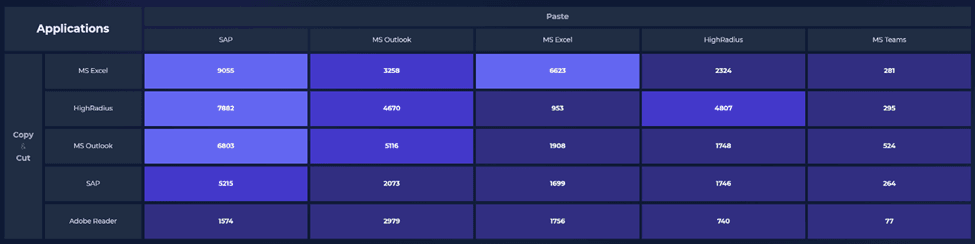
Think about it. We hire brilliant, highly educated professionals, and instead of using their problem-solving skills, we force them to act like manual data bridges.

We have them frantically copying information out of a modern CRM and pasting it into an outdated mainframe database that hasn’t been upgraded in a decade.

You are paying for their intellect, but you are treating them like a human API.
It is a massive waste of human potential, and Process Intelligence finally puts a hard dollar amount on exactly how much that “meatware” gap is costing the business.
To give you an idea of how extreme these situations can get, let me share a real-world scenario from an insurance company. They had a large team handling customer calls. On paper, their call-handling process looked completely standard. But the Process Intelligence data revealed a very bizarre, hidden pattern: during every single call, employees were aggressively opening and typing into electronic sticky notes on their desktops.
Why were they doing this? It turned out that the company’s core ERP system was so impossibly slow that it couldn’t record data live while the customer was speaking. If the agent tried to type directly into the official system, the lag was so severe it would result in awkward, endless silences on the phone. So, the frontline workers created a workaround trap out of pure desperation. They rapidly typed all the crucial customer information into sticky notes just to keep the conversation flowing smoothly. Then, after the calls were done, they would spend precious time copy-pasting all of that data from the sticky notes back into the painfully slow ERP.
The leadership was stunned. For months, they thought they had an efficiency problem and were frustrated that call volumes were low. In reality, they had a critical software failure, and their employees were heroically – and exhaustingly – patching the system together every single day just to keep the lights on.
That is the true power of Process Intelligence. It stops the blame game in its tracks. It proves that before you demand your workforce to move faster, you have to verify that their tools aren’t actively holding them back.
The Human-Centric ROI: Morale and “sanity”
What does all of this actually mean for the people sitting in the chairs? This brings us to a part of Process Intelligence that rarely makes it into the standard executive pitch, but is arguably the most important: The Human-Centric ROI.
When organizations talk about ROI, they are usually just looking at a spreadsheet and calculating dollars saved per quarter. But the real, sustainable return on investment is measured in morale and sanity.
Let’s talk about the battle between engagement and burnout. Human beings are not wired to do mindless, repetitive work for eight hours a day. We crave what psychologists call the “Flow” state – that perfect balance where the challenge of a task matches our capability. But you cannot achieve Flow when your day is constantly interrupted by digital friction. Every time an employee has to stop problem-solving to manually copy-paste data between two disconnected systems, you are draining their engagement. By using Process Intelligence to identify and eliminate those soul-crushing, robotic tasks, you aren’t just speeding up a process; you are giving your team their brains back.

And yes, efficiency gains do impact headcount, but not in the terrifying way that most people assume. Let’s look back at Vesuvius. When they rolled out KYP.ai, they didn’t use the data to blindly swing an axe and lay people off. Instead, they worked smart. By streamlining their processes and removing that digital friction, they hit a break-even ROI on the software in just six months. But more impressively, they achieved an 8% workforce reduction purely through natural attrition. When people naturally retired or moved on to other opportunities, Vesuvius simply didn’t need to backfill those roles. The remaining team was so efficient, and the workload was so well-balanced, that they easily absorbed the work without breaking a sweat. It was a healthy, sustainable right-sizing of the organization.
But the data doesn’t just help with balancing the load; it can fundamentally change how we reward people. We are seeing forward-thinking companies take the Process Intelligence data and use it to build incredibly fair, transparent incentive programs. Think about the traditional corporate bonus structure – it is often highly subjective, heavily influenced by office politics, or based on who talks the loudest in meetings. Now, imagine giving every employee an individual dashboard where they can see exactly how their productivity is being measured, in real-time. It completely levels the playing field. You create a data-driven bonus system where people are rewarded for the actual, quantifiable work they do. It removes the bias and replaces it with undeniable proof of performance.
Conclusion: Sanity is the ultimate ROI
Ultimately, if you are an executive or an operations leader, you need to stop looking at Process Intelligence as a tool for corporate surveillance. It is the exact opposite. It is a megaphone for your employees.
For years, your frontline workers have been trying to tell you that the legacy systems are crashing, that the workflows are broken, and that they are spending half their day fighting the software. Process Intelligence takes those hallway complaints and backs them up with undeniable, hard data. It proves to leadership that the “one little system quirk” everyone complains about is actually costing the company thousands of hours a month. It validates the daily struggles of your team and forces management to actually do something about it.
So, here is the final thought I want to leave you with today. The end goal of rolling out a tool like KYP isn’t just about shaving three seconds off a transaction time or making a perfectly optimized flowchart. The ultimate ROI is sanity. It is about taking a hard, honest look at the messy reality of your operations, and making the conscious decision to fix it.
We hire humans because of their intellect, their creativity, and their ability to solve complex problems. It is time we stop forcing them to act like bots, and start using data to give them an environment where they can actually do their best work.


